
The Book Group Chapter 40
theatre

Lulworth Army Camp.
Dorset.
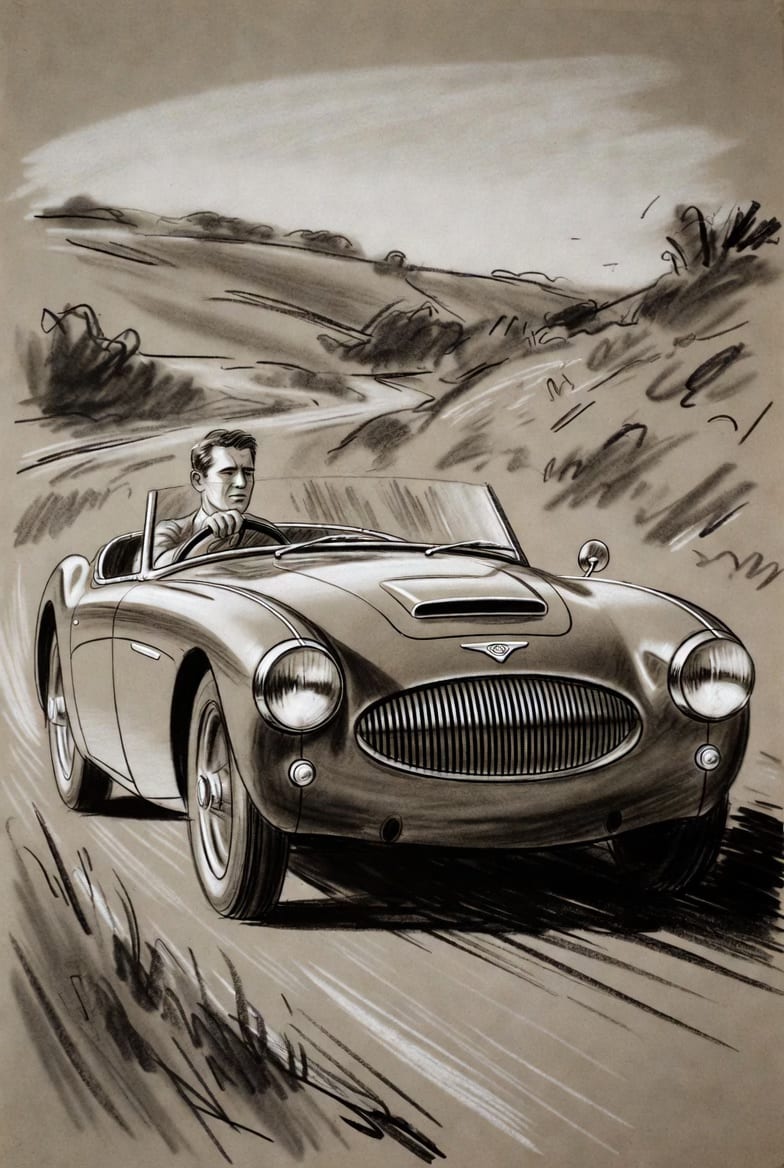
Paul slowed to a halt at the gate. The drive down from London had been fun. A dry day with little wind, and the car was a delight to drive, full of, how would Penny describe it?, full of shenanigans.
Winding down the window he showed his papers to the sentry, who studied them and handed them back. ‘Officer’s quarters to the right, Major.’
‘I’m looking for the armourer. Sergeant Mooney.’
‘Turn left at the T-junction, then right, for the armourer’s workshop.’
‘Same as always.’
The guard leaned forward a little, conspiratorially, ‘The rumour is, Sergeant Mooney hasn’t left his bench since the summer of ’39.’
‘I heard it was the summer of ’36.’
The guard smiled, straightened up, gave a brisk salute. Paul, in the driver’s seat of the low-slung Austin Healey, responded in kind, popped it into gear and drove on when the bar lifted.
The armourer’s workshop was, in truth, a huge aircraft hangar. Lulworth housed the gunnery school for all British armoured regiments, so there were tanks and armoured cars lined outside the workshop as if on parade, and once Paul parked the Austin and walked through the large hangar doors he saw many more steel battle-vehicles in various states of undress: some had been stripped down to the bare carcass, others appeared in need of a nothing more than a new track. One armoured car sported a 75mm barrel that had petaled at the front, due to some ammunition malfunction and the subsequent explosion within the barrel itself.
Paul smelled fuel oil, stale cordite and steel as he walked to the rear of the workshop, it reminded him of war, and he felt comforted somehow. He spotted various men in overalls clambering over or in or out of vehicles as they laboured to fix them up to war readiness, though right now Britain was not officially at war with anyone. And even though he was in civvies, a couple of men recognised him as an officer and saluted him as he passed, and so he saluted in return. He stopped a corporal and asked where Sergeant Mooney’s workshop was.
‘Small arms are over to the right sir, you can’t miss it, the door has a Bren gun barrel for a handle.’
As promised, Paul found it easy enough. He knocked, turned the former machine gun barrel, and entered, just as a voice shouted ‘Come in!’
Paul opened the door to find Penny standing there. ‘Hello,’ he said.
‘You’re going away,’ she said.
He tried to think of a lie but couldn’t, so said. ‘I have to.’
‘No. You don’t have to.’ She looked over his shoulder to where his half-packed suitcase sat on the hall table. ‘You don’t have to at all.’
‘This last job then I’m done.’
She shook her head. ‘If you do this job, you’re done. You did things in the war, lots of men did, some women too, but this isn’t war, Paul, this is murder. If you do this, what does that make you?’
Though there was no one within earshot - his apartment was at the top of three flights of stairs, and no one else was around - her raised voice made him uncomfortable. He sighed and said, ‘Come in.’
‘Mr. Carter sir,’ came a greeting from the shadows.
Paul approached, seeing Sergeant Ray Mooney rising from a bench on which sat a rifle bolt and a file. Mooney grabbed a rag and wiped his hands, saluted. Paul did likewise.
‘Good to see you, Ray.’
‘You too, Mr. Carter. Popped in for a cup of tea? I’m just about to make a brew.’
‘It’s official business, I’m afraid.’
Mooney frowned. ‘I thought you were demobbed, Sir.’
‘Tea?’ He led her into the living room.
‘Yes please.’
He left the room and a couple of minutes went by before he returned with two teas. ‘No biscuits, I’m afraid. Forgot to ask Sid for a resupply.’
Part of Penny wanted to tell him that she should be the one stocking up on tea and biscuits and milk for guests… she put that thought away.
He sat down, facing her, and after a brief pause while they both went through the motions of drinking the tea, he said, ‘So.’
‘So,’ Paul said. ‘The specs. Target will be two hundred yards away. I’ll be in a room about fifteen feet above the ground. It has to be subsonic.’
Ray looked up.
‘It’s in a public place.’
‘Subsonic,’ Ray said. ‘Two hundred yards. That’ll take almost a second to arrive. Stationary or moving?’
‘Walking left to right.’
‘Young or old?’
‘Young. About my age.’
Ray nodded, wrote as he spoke. Say, three yards a second.‘ He looked up from his notes. ‘And side profile too, so a smaller target.’
‘It will be one shot. I’ll have a four-second window.’
Ray sat back. ‘With a normal rifle and ammo, you’d make that shot easy, Mr. Carter, but subsonic, that means you’ll be leading the target by eight or nine feet in front and fifteen feet over his head. With a four second window, discount the first and last, so that gives you two seconds in the middle in which you can pull the trigger. Now that is not an easy shot to make.’
‘I might need some practice,’ Paul conceded.
‘I think you might. But first, we need to find you something suitable to lob a subsonic round at a moving target six hundred feet away.’
Penny sighed. ‘The gold. It’s your foundational sin, isn’t it? Everything you have and everything you must do is due to that damned shiny metal.’ Penny looked anguished. ‘Oh Paul, why couldn’t you have got a bloody bank loan like everyone else?’
He gave a rueful smile. ‘The banks aren’t lending money to penniless ex-soldiers right now, Penny. The war bankrupted the nation and Mr. Atlee is taxing whatever spare change is left over. Besides, when I came across the gold, I had no idea it would lead me here. It just seemed like a bit of a caper, payment in kind for five bloody hard years, you might say. I’d seen friends killed, innocents die, and I’d seen monsters emerge completely unscathed from the war, and it didn’t seem like a time for the finer moral questions, so I just grabbed what I could. Besides, I only took a bit of it. I’m pretty sure the Mayor took an ingot or ten, as did the MPs who carried it back, and the quartermaster who tallied it all up when it arrived.’
‘Oh, I don’t mind that you stole some gold in the dog days of the war, Paul. I mean, why not? Daddy has friends who made an absolute pile from the war, and their sons never went near the field of battle. Besides, it makes you more dashing to think you’re a bit piratical. But the fact you took it means that that Whitehall chap,’ she couldn’t bring herself to say his name at this moment, ‘well, he’s got you nip and tuck.’
‘Jungle Carbine,’ Ray said.
‘Don’t they have a wandering zero?’
‘Not this one. She’s a beauty. Marksman grade.’ He glanced at Paul, ‘I’m guessing you won’t be returning her.’
‘I’m afraid not.’ Paul picked it up, looked through the telescopic sight.’
‘ZF41,’ Ray said.
‘Those krauts make good optics,’ Paul said.
‘I’ll have to make a custom silencer for it. I’ll grind off the serial numbers, so she’ll just be another bit of kit with no provenance. A lot of stuff went missing during the war.’
‘Indeed,’ Paul said.
‘That is my situation,’ Paul said. ‘I’m in a pickle and there’s no way out.’
‘So you, what, you go out and murder someone and then return to normal life as a bookseller?’
‘He’s a spy, Penny. A double agent. He’s responsible for a lot of good men dying.’
Penny picked up her cup of tea and took a sip. ‘You do make good tea,’ she said. ‘Seems a shame to see you hang for murder in some foreign country, when you can make tea this good.’ She put down her cup. ‘And of course, after you go, the shop will close down and we’ll all be out of a job, and forever tainted by association with you.’
‘Don’t be so melodramatic, Penny. I’m not going to hang. I’m not going to get caught.’
Penny looked at him. Dear, stupid, foolish Paul, she thought. So worldly and yet so naive. ‘Of course you will be caught. Can’t you see? You’re perfect. A random stranger shoots someone and then gets caught. Like they say in the movies, you’re the patsy. A quick trial, and a quicker execution. All problems solved, all loose ends tied up in a neat little bow.’
Paul said nothing.
He worked the bolt of the carbine. It was smooth and fast, all Lee Enfields were, it was baked into their design, but he didn’t need smooth, or fast, just accurate. ‘Can we go and test this out, Ray?’
‘I’ll need to get make up some custom rounds. Off-the-shelf velocity for a point-three-oh-three is around twenty-four hundred feet a second. You need to reduce that by sixty per cent.’
Paul handed him back the rifle, and he could see that Mooney looked perturbed. ‘What’s up, Sergeant?’
‘Mind if I speak freely, Major Carter?’
‘Of course. I don’t want any technical problems hanging over me.’
‘This isn’t a technical issue. It’s more, well, a moral one.’
‘Can’t you just do what you did with that academic chappie and stash him away somewhere?’
‘No. This has to be done in public in the middle of the day. There’s to be no doubt that it happened.’
‘Why the middle of the day?’
‘It’s the only time he appears.’
‘And in public,’ she echoed.
‘So there’s no way to spirit him away under cover of darkness,’ Paul confirmed.
‘In public. In the middle of the day. Seems theatrical,’ she said.
‘I think that’s rather the point.’
‘Do you trust him, Paul? Sir Timothy-bloody-Taes. Do you actually trust him?’
‘Moral?’
‘You see, sir, when we was at war, and me knowing something of what you did out there, I’d have been happy to build you a blow pipe or a portable guillotine if it meant the war would end a day sooner. But we’re not at war now, are we?’
‘Go on, Sergeant.’
‘And you’re planning to shoot someone in a public place, in cold blood. Well, to be honest sir, it doesn’t feel quite right.’
‘You have qualms.’
‘That I do. I mean, I’ll build you whatever you need, and I’ll make sure it works perfect: I’m a sergeant in the British army and I follow orders. But I always thought you were one of the good guys, Major. Like in the movies when the cowboy wears a white hat, and you think to yourself, he’s the good guy. And good guys don’t shoot people in the street from two hundred yards with a rifle.’
‘I’m a white hat?’
‘I’d like to think so, sir.’
There was a long moment of silence but Paul’s frown broke into an extremely slow-building smile. Finally, he was grinning. ‘That’s why I like you the best, Ray,’ he said, slapping Mooney on the shoulder in a very un-officer-like way. He was almost laughing. ‘Of all the armourers I’ve ever met, you’re my favourite by far.’
‘How many armourers have you met, Mr. Carter?’ Mooney said, looking even more perturbed by the Major’s change of mood.
‘Only one, but I keep my eye out for others,’ Paul said, still smiling.
Sergeant Ray Mooney looked more than a bit doubtful.
Paul said, ‘Don’t worry. I haven’t lost my marbles, Sergeant. Now, I’m going to tell you something. Something very secret. I hope you can keep it to yourself.’
‘I don’t trust him at all, Penny.’
‘Do you think he’ll keep his end of the deal?’
‘I think there’s a good chance he won’t. But I also think I have no choice.’
‘My brother was in Guards Armoured during the war,’ Penny said. He said there were three certainties in life. Death, taxes, and German…’
‘…counter-attacks.’
She smiled. She really did have a pretty face, he thought. She said, ‘So tell me this, why aren’t you fighting back? Surely there’s something you can do.’
‘I’ve racked my brains, come up with all sorts of convoluted plans, none of them workable.’ He sighed. ‘I realised that trying to change the way things are, that’s just me being silly.’ He glanced at her as he spoke. Even when frowning, she looked lovely, he thought, feeling a sudden warm tenderness towards her.
‘You buying a derelict bookshop on a Chelsea side street and calling it home is silly, Paul. Me thinking I could help you make a success of it is silly. And yet here we are. And it worked.’ She stared at the wall, thinking. ‘Perhaps silliness is more than it’s cracked up to be. Perhaps silly is a good thing.’ She looked back at him, her eyes clear, smiling at him, for which he was unexpectedly pleased. ‘So why don’t we make a silly plan?’
‘Fly to Mars, silly?’ he said.
She grimaced.
‘Reopen as a grocery store,’ she said. ‘In Darlington.’
It was his turn to grimace now, then he said, ‘Bury our heads in the sand and hope the problem goes away?’
‘Better,’ she said, ‘But we have no sand.’
‘Pretend we’re insane, and sign ourselves into an asylum.’
‘Closer still,’ she said.
‘Pretend we’re someone else and we didn’t do it?’ he said, glancing at her. Penny had a look of concentration on her face. He could see she was homing in on something.
‘How’s about,’ she said, speaking slowly, still catching up with her thought process. ‘How’s about we pretend to do it. But we don’t do it.’
‘Who’s this “We?”’
Penny smiled again, and Paul suddenly realised something. Something he’d known for months, a year even, but had never really allowed himself to think about, and it was this emotion, ultimately, that persuaded him, not what Penny said next.
‘”We” are the people who are not going to do the thing that “We” are supposed to do,’ she said. ‘Because we are not assassins, we are not the bad guys, and we are not going to be blackmailed or duped into taking the fall for some dreadful man in Whitehall.’
‘If we’re not the bad guys, then who are we?’ Paul asked.
‘We’re book sellers.’
‘A fine trade,’ Paul said. ‘We’re book people.’
Penny looked away, remembering something, then glanced back at him. ‘We’re The Book Group.’
‘The book group,’ he said.
‘All capitals,’ she added.
‘All capitals,’ he repeated.
‘We’re The Book Group,’ she said, ‘and we’re not putting up with these shenanigans any longer.’
‘Right.’
‘So all we have to do is work out a way to do the thing, without actually doing the thing. They want theatre? We’ll give them bloody theatre.’
I’m an independent writer with a mission to write serial novels that are freely available to read. I depend on readers for support, so if you can help with a paid subscription or by spreading the word to other readers, I’d be very grateful.
OK, I'm hooked all over again.