
The Book Group 46
tourists

Taes left his house on Holland Park Mews just after 6pm, carrying a brolly for the rain and a lightweight canvas holdall. He walked the fifty yards to Holland Park Avenue and flagged a cab. The journey to Harwich was about ninety-five miles and he had to negotiate the fare with the cabbie. After they’d agreed a price, and he’d paid up front, he clambered in, settled back in the seat and closed his eyes. Harwich was a good three hour drive and he was tired. As evening drew on, the only noise was the pitter patter of rain on the windscreen and the mild snoring form the passenger seat in the back. The driver hummed a tune to himself as he drove his passenger towards the Essex coast.
Taes woke an hour later feeling a little refreshed and quite relaxed. The plan had gone as expected, Paul was nothing if not a good assassin, and that little favour, the killing of an outspoken priest, would please his friends behind the curtain. It might result in more kindly treatment during the expected and no-doubt severe debriefing. But that was nothing, he’d dealt it out many times, and it was his turn to endure it. He smiled to himself as he stared out into the night, seeing his reflection smile back. The English were fools. They’d only survived the war through a combination of stubbornness and blind good fortune. As an Irishman by birth he’d never felt a particular loyalty to the bumbling idiots he worked for, or the empire they represented. Not for the first time, he wondered at how such an insignificant little island had found themselves with the largest empire the world had ever seen. ‘Chance,’ he muttered.
‘What’s that, guvna?’ the driver asked, glancing in the mirror.
‘Talking to myself.’
The driver nodded, and slid shut the glass window that separated the driver’s compartment from the passengers. No, Taes thought, it’s time for a new world order. An order based on equality for all, run by men such as himself. He’d already decided that, after he got settled into his dacha, he’d reach out, gently of course, and offer his services in a more practical form. He had no intention of spending the next twenty or thirty years sitting on the shingle beach at Morskaya doing nothing. He had an active mind and he knew he could be of good use.
He tapped the window, which slid open.
‘Yes, guvna?’
‘What road are we on?’
‘A12. Just skirting Chelmsford. About halfway there. Would you like to stop off for a cuppa somewhere? I know a couple of late-opening cafes.’
‘No thankyou. I think I’ll push on.’
‘You’re the boss.’
The glass slid shut. Taes shut his eyes again. Plenty of time to think of the future. He had a midnight trawler to catch. He hoped the weather was fair, had only ever been to sea once before and was badly seasick. Still, he mused… and then he was asleep.
Fifteen minutes later the driver glanced in his rear-view mirror and saw his charge was sound asleep. Probably just as well, he thought. Easier to get him where he was going, he thought, as he turned right off the A12 and took the B-road to Colchester.
Sir Timothy woke to a tap tap tap on the window. He woke with a start, ‘Are we here?’ he muttered, dragging himself away from the most pleasant of dreams. The cab door opened, but it was not the cab driver who opened it. Instead, there were two men in suits and hats, raincoated against the weather, and they were flanked by two police officers. ‘What’s this?’ he said.
But he knew what it was.
In the interview room he sat motionless, an untouched cup of tea in front of him. He’d been there over an hour and they’d been unfailingly polite. This was his second cup of tea. His interrogator, who’d introduced himself as Foggin, was mild, patient, and had a faintly amused look on his face. Taes would have preferred anger or fury . Humour suggested that they knew something he didn’t. ‘So,’ Foggin said. ‘You arranged for the assassination of a prominent Jewish academic in the Home Counties, then a dissident Polish priest in Rome. You’re quite the ecumenical murderer, I’ll give you that.’
‘I want my lawyer,’ Taes said.
‘But you didn’t just switch sides the last couple of months, did you?’
‘Lawyer.’
‘You don’t get a lawyer, Mr. Taes.’
‘Sir Timothy Taes.’
‘You don’t get honours either,’ Foggin said. ‘We know who you are. We know what you do. What you’ve done. We’re not even here to question you.’
‘Then why am I here?’
‘We’ll keep you here just long enough that your paymasters get wind that you stopped off on the way to the trawler, then we’ll send you on your way.’
‘Why?’
But he knew why. He’d be tainted in the eyes of the Russians. Assuming he survived the debrief, he wouldn’t get a dacha, he’d be lucky to get a single cell in a gulag. His stomach felt heavy at the thought.
‘Let’s say I tell you everything,’ he said, switching smoothly to negotiation mode. ‘Let’s say I give you names, address, dates, operations.’
‘Let’s say we put you on that trawler,’ Foggin said. ‘You’re done Mr. Taes. You are what you’ve always been, an Irish gobshite on the make.’ He paused, adding, ‘And on the take.’
Taes’ face fell, but then he rallied. This was no time for protestations of innocence. He’d try a different approach. ‘Who was it?’ he asked. ‘Sir Luke Short? I always thought he seemed a bit sniffy?’
‘Not Sir Luke. Nor Norman Hyde, Nor any of the others you worked directly with during the war. We had you pinned long before that.’
Taes almost raised a smile. ‘I don’t believe you.’
The interrogator leaned forward, elbows on the table, comfortable, his smile was quite gentle. ‘We’d double you, or in this case, triple you, but we don’t need you. Besides, and this might sound silly, but we can’t trust you.’
‘You think I’d go double double?’
‘How could we tell?’ Foggin sat back. Shuffled the papers in front of him into a neat piled. ‘No. You’re getting on the trawler. It’s been delayed by customs. Then the tide. You’ll make it around seven in the morning, and when you arrive in Moscow, everything you ever told them, or will tell them, is suspect.’
Taes realised his options were diminishing. His neck felt hot. He became angry. ‘You fucking English think you’re so smart,’ he said. ‘The war bankrupted you. America has replaced you. This pathetic country is never going to recover…’
‘And yet here were are,’ Foggin mused, ‘Muddling through. It does seem to be our greatest strength.’
‘Stalin will show you what real strength looks like.’
‘Do you know what Stalin does to spies?’ Foggin said. ‘We do. They tell us. They even send us film. Not sure why. Suffice it to say, they’re not kind. And you failed too, with the last two at least. Both academic and priest are alive and well. Which Moscow will know soon enough.’
Taes picked up the teacup and took a sip. His mouth had gone dry. He wondered how they’d faked the Rome assassination.
‘I need to speak to you,’ Penny said to the priest, glancing over her shoulder as she stepped close. ‘Could you hold this for a moment, please?’
And as the priest, slightly dumbfounded by this request, held out his hands, Penny pushed the bag close to his chest and pressed the trigger on the stun gun inside. Three hundred thousand volts coursed through the priest, burning a hole in his shirt, shocking him into unconsciousness, and he collapsed to the floor. She stepped back, shocked, the smell of burning and the thud of him hitting the ground sickening her for a moment.
She screamed.
A man stepped forward to check on the priest, and suddenly there was a patch of glistening red on the front of his shirt, just below his dog collar. Oh God, she thought, had he really been shot? But then the man turned and it was Sid, and he winked, then stepped away. She screamed again. Louder.
Almost two hundred yards away, the spy watched events unfold. Satisfied, he ran to call Taes, stopping on the way to tell a police officer what had just taken place. After he’d made the call, he returned to the cafe for a tazzato but even as the espresso arrived he saw a man, dressed only in his underwear, his head covered by a towel, being bundled out of the hotel and into a waiting van by four Carabinieri. The spy drank his coffee in one gulp and returned to the phone to update Taes.
A couple of mutes earlier, Vivien had stood at the window on the first floor of the hotel. She could see the spy below her but he could not see her through the net curtains. She watched through the colonnades as Penny approach the priest, then she turned back to the bishop, who was in his underwear, kneeling on the bed beside her, expectant. She slapped him hard with a table tennis bat. It made a loud popping sound. It was a special bat, with two blades that slammed together like a slapstick. It had been made specially, by an armourer in England. ‘You bad boy,’ Vivien whispered, to the priest, her voice sultry, her attention barely on him. ‘You naughty boy,’ she said.
In the distance she heard a scream. Then another. In the open air cafe below, she watched the spy stand and walk quickly away. Turning back to the priest, she checked her watch. ‘I have to go to the ladies room,’ she said to the unfrocked priest. ‘Can you wait?’
‘N’andare,’ the priest whispered, and even from behind, his excitement was visible.
‘Five minutes,’ Vivien said, her voice husky. ‘And if you move an inch, I shall scold you.’
She left the hotel room, walked down the stairs and out into the street, the bright sunshine catching her eyes for a moment, so that she took her sunglasses from her clutch bag and slid them on, then she turned and walked away, disappearing in the crowds.
Not much more than five minutes later, Carabinieri arrived at the hotel room looking for a gunman but instead discovered an obviously aroused man dressed only in long underwear, blindfolded, still kneeling on the bed. When it turned out he was a Bishop, their laughter turned to consternation, and when it was discovered his outer clothes had entirely disappeared, they covered his head with a large towel and ran him out of the hotel to the nearest police vehicle.
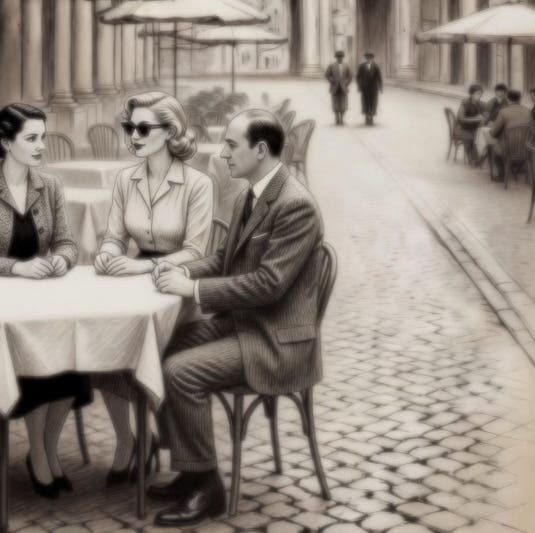
A half hour later, Sid, Vivien and Penny were sitting at their rendezvouz point, a cafe on a quiet street close to Castel Sant’Angelo. They chatted, laughed, talked loudly in their excitement and relief that the plan had worked. But after a while they grew quiet. They waited for the final member of The Book Group to arrive.
Paul himself having just packed his bag, was exiting his hotel room on the second floor, leaving behind the hard case containing the telescopic-lens camera and its tripod. He walked down the stairs to the foyer and paid his bill. Then he left the hotel, and walked through the crowds toward the meeting-pace. He felt himself relax a little, allowed himself to enjoy this brief visit to Rome. Maybe he could take in some of the tourist spots before he left. As he walked, he thought a number of things. Chiefly, he wondered at Penny.
She really was the most, he thought.
I’m an independent writer with a mission to write online serial novels and short stories that are freely available to read. I depend on readers for support, so it would be great if you could help with a like, a comment, or by spreading the word.
OK ... now you have to explain how they faked the killing in the country. Great serial, James.